Diode Laser vs IPL for Hair Removal: Why the Machine Decides Safety on Indian Skin
“Laser hair removal” in Jaipur is advertised at prices that differ by three or four times for the same area, and the biggest reason is that not all of it is laser. Intense pulsed light, IPL, is a broad-spectrum flash lamp; a diode laser is a single, chosen wavelength. Both heat hair follicles through melanin, which is exactly the problem: Indian skin has melanin everywhere, not only in the hair, and a machine that cannot tell the two apart heats the skin as well as the follicle. This comparison explains the physics in plain terms, why it matters more for darker skin than for lighter, what home IPL devices actually deliver, and how to tell what a clinic is really using.
Content verified by Dr. Aakriti Mehra · Last reviewed October 2026 Editorial policy
4.9 · 30 Google reviews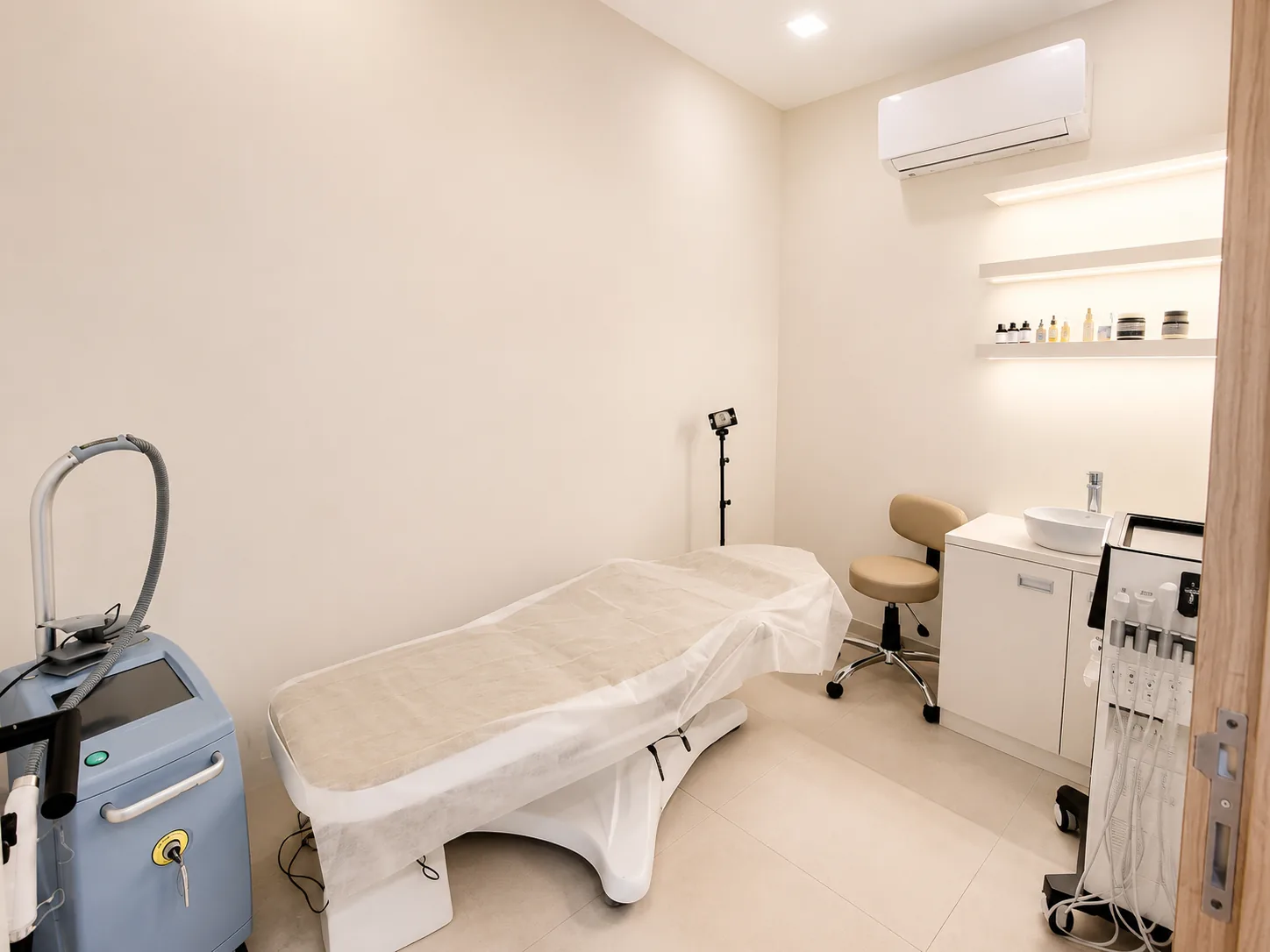

Side by side
| Diode laser (multi-wavelength) | IPL | |
|---|---|---|
| Light source | A laser: one or several precise wavelengths (755, 810, 1064 nm on our platform) | A flash lamp: a broad band from about 500 to 1,200 nm, filtered |
| Targeting | Wavelength chosen for hair melanin against skin melanin | Cannot be tuned; much of the energy is absorbed by skin |
| Depth | Deep enough for the follicle bulb; 1064 nm passes beyond epidermal melanin | Shallow; scattered across depths |
| Safety on skin types IV–VI (most Indian skin) | Good with correct settings, cooling and the 1064 nm option | Poor to moderate; higher burn and pigmentation risk |
| Sessions for a course | 6–8 | 8–12, with more partial responses |
| Sensation | Warm snap, cooled handpiece; in-motion technique is comfortable | Hot flashes; often more uncomfortable on dark skin |
| Fine or light hair | Limited (needs melanin) | Limited |
| Typical Jaipur price per session | Higher — our underarm session is ₹3,000 | Lower — often ₹800–1,500 |
| Home devices | Not available at clinical power | Common; very low power, tanned skin excluded |
The physics in one paragraph
Hair removal by light works by selective photothermolysis: a wavelength that melanin absorbs strongly is delivered in a pulse short enough to heat the follicle before the heat spreads, destroying the bulb without cooking the surrounding tissue. Selectivity is the key word. On fair skin with dark hair, almost any red-to-infrared light is selective because the only melanin around is in the hair. On brown skin, the epidermis is full of melanin too, so the choice of wavelength matters: shorter wavelengths (755 nm and the IPL band) are absorbed heavily by the surface, longer ones (810 and especially 1064 nm) pass through to the follicle with less surface heating. A diode platform that offers all three, with contact cooling, can be set for the skin in front of it. A flash lamp cannot.
Multi-wavelength diode laser — the three wavelengths and when we use each →
What goes wrong with IPL on darker skin
- Burns: the surface absorbs energy meant for the follicle; a clinic compensates by lowering the energy, which then fails to disable the hair
- Post-inflammatory pigmentation: dark patches in the shape of the handpiece, weeks later, needing their own treatment
- Paradoxical growth: low, sub-therapeutic energy can stimulate rather than disable fine hair, a recognised problem on the face
- More sessions and more partial results, because the effective dose at the follicle is low
- A false economy: the ₹1,000 session that needs twelve visits and a pigmentation plan afterwards
Home IPL devices: what they actually do
Home IPL devices sold in India deliver a small fraction of clinical energy, by design, so that an untrained user cannot burn themselves. Most carry a skin-tone sensor that refuses to fire on darker or tanned skin — which excludes a large share of Indian users, and all of them after a summer. Used consistently for months on lighter skin with dark hair, they reduce hair modestly and temporarily; stopped, the hair returns. They are not a course of laser hair removal, and they are a poor substitute for anyone with skin type IV or darker.
How to tell what a clinic is using
- Ask for the machine type and wavelength. “Diode” with a number in nanometres is an answer; “laser” alone, or “IPL laser”, is not.
- Ask whether it has a 1064 nm option or a dark-skin setting, and whether the handpiece cools the skin.
- Ask whether a patch test is done, and what happens if you arrive tanned — a clinic that treats tanned skin on any machine is a clinic to avoid.
- Look at the price. A full-face session at ₹1,000 is almost never a diode laser.
- Ask who sets the parameters: a trained therapist under a doctor’s protocol, or whoever is free.
Laser hair removal cost in Jaipur — what the price should include →
Where IPL still has a place
IPL is a legitimate device for other jobs — redness, broken capillaries and some sun damage on lighter skin — and for hair removal on fair skin with dark hair it works, if more slowly than a laser. The problem is not IPL; it is IPL on Indian skin for hair removal, marketed as laser. If you are skin type I–III with dark hair and the price difference matters, IPL at a clinic that patch-tests is a defensible choice. For most of Jaipur, it is not.
What we use, and why
Our hair removal runs on a multi-wavelength diode platform with contact cooling, patch-tested, set by a trained therapist from the skin type, hair type and area, and withheld from tanned skin and from pregnancy under our treatment rules. The session costs more than an IPL session, needs fewer visits, and leaves the skin as it found it. The comparison with IPL is not close, and we would rather explain why than compete on a price for a different product.
Laser hair removal aftercare — the week after a diode session →
Diode laser vs IPL: frequently asked questions
What is the difference between diode laser and IPL?
A diode laser emits one or several precise wavelengths chosen to target hair melanin; IPL is a broad-spectrum flash lamp whose energy is absorbed by skin as well as hair. On darker skin the laser is more selective, safer and needs fewer sessions.
Is IPL safe for Indian skin?
For hair removal, poorly. The epidermis absorbs much of the energy, raising burn and pigmentation risk, and the energy that reaches the follicle is often too low to work. A diode laser with an 810 or 1064 nm option is the safer tool.
Why is IPL cheaper than laser?
The device costs a fraction of a diode platform, and sessions are faster. The saving is offset by more sessions, partial results and the risk of treating pigmentation afterwards.
Do home IPL devices work?
Modestly and temporarily on lighter skin with dark hair, used consistently for months. Most refuse to fire on darker or tanned skin and none deliver a clinical course.
How many sessions does each need?
Diode laser six to eight; IPL eight to twelve, with more partial responses on darker skin.
How do I know if a clinic uses a real laser?
Ask for the machine type and wavelength in nanometres, whether it has a 1064 nm or dark-skin setting and contact cooling, and whether it patch-tests and refuses tanned skin. A full-face session at ₹1,000 is almost never a diode laser.