Microneedling and RF Microneedling: Controlled Injury, Real Remodelling
Microneedling is the simplest idea in regenerative skin care: injure the skin in a precise, controlled way, and let the repair response do the work. A pen or roller studded with fine needles creates thousands of microscopic channels; the skin seals them within hours and spends the following weeks rebuilding collagen underneath. Add radiofrequency delivered through the needle tips and the same idea becomes one of the most effective treatments for pitted acne scars and enlarged pores on Indian skin — because the heat goes into the dermis where scars live and never touches the pigmented surface. This page explains both versions, why 1.5 mm is our working depth, what we infuse afterwards, and who should not have it.
Content verified by Dr. Aakriti Mehra
4.9 · 30 Google reviews

Plain microneedling: collagen induction
A motorised pen oscillates a cartridge of fine needles into the skin at a set depth, or a roller with needles around a drum is passed across the surface. Either way, each needle creates a channel through the epidermis into the upper dermis and withdraws, leaving the surface almost intact — the channels close within hours. The dermis, though, registers thousands of tiny wounds and responds as it would to any injury: growth factors are released, fibroblasts migrate in, and over four to six weeks new collagen and elastin are laid down in an organised pattern. Repeated over a series, this thickens the dermis, smooths texture, softens shallow scars and fine lines, and — because the channels are open for a short while — delivers whatever is applied on top far deeper than skin would normally allow.
Why 1.5 mm
Our pen and roller are set to 1.5 mm. Shallower than about 0.5 mm reaches only the epidermis and is useful for product delivery alone; deeper than 2 mm on the face increases bleeding and downtime without proportionate benefit for most indications and raises the darkening risk on Indian skin. At 1.5 mm the needles reach the upper and mid dermis where acne scarring and texture problems sit, with manageable downtime — the practical working depth for the face.
RF microneedling: heat where the scar is
The RF version uses the same needle-array principle but the needles are electrodes. Once inserted to depth, a pulse of radiofrequency energy passes between them, heating a controlled column of dermis around each needle tip to the temperature at which collagen contracts and remodelling is triggered. The crucial design point for darker skin is that many RF needles are insulated along their shaft and deliver energy only at the tip: the epidermis — the layer that makes pigment and darkens when injured — is pierced but not heated. That is what makes fractional RF microneedling the scar treatment of choice for Fitzpatrick types IV and V, where ablative lasers that burn the surface carry an unacceptable risk of post-inflammatory hyperpigmentation.
The combination of mechanical channel plus thermal column produces a stronger remodelling signal than either alone. Pitted scars lift as new collagen fills beneath them, pores tighten as the surrounding dermis firms, and laxity in the lower face improves — a secondary benefit the RF adds that plain needling does not.
At a glance
| Microneedling (pen / roller) | RF microneedling | |
|---|---|---|
| Mechanism | Mechanical micro-channels → collagen induction | Micro-channels + radiofrequency heat columns in the dermis |
| Depth at the clinic | 1.5 mm | 1.5 mm |
| Best for | Texture, fine lines, product delivery, scalp | Pitted acne scars, enlarged pores, early laxity |
| Downtime | Pinkness for 1–2 days | Pinkness and mild swelling for 2–3 days; faint grid marks briefly |
| Sessions | 3–6, four to six weeks apart | 3–4, four to six weeks apart |
| Pigment risk on Indian skin | Low at 1.5 mm with aftercare | Low — surface spared by insulated needles |
Radiofrequency — the same energy without needles, for tightening →
What we deliver through the channels
Microneedling is as much a delivery system as a treatment. In the minutes after needling, the channels are open and the skin absorbs what is applied at a rate it never otherwise could. Our protocols use this deliberately:
| Applied after needling | Protocol | Purpose |
|---|---|---|
| Platelet-rich plasma (your own) | Vampire PRP Facial; PRP hair treatment | Your own growth factors into the dermis or scalp |
| PDRN | Salmon Facial; scar and texture plans | Repair signalling and faster, calmer healing |
| Exosomes | Exosome hair treatment; regenerative skin boosters | Lab-derived regenerative signalling |
| Hyaluronic acid | Skin boosters | Hydration from within the dermis |
How AI Aesthetics plans a needling session
- Doctor-led assessment of scar type — rolling and boxcar scars respond; deep ice-pick scars may need additional techniques — and a check for active acne, which must be controlled first
- The energy-device gates for RF: a compromised barrier, strong redness, very low hydration or a surface temperature of 36.9 °C or more deny or reduce it
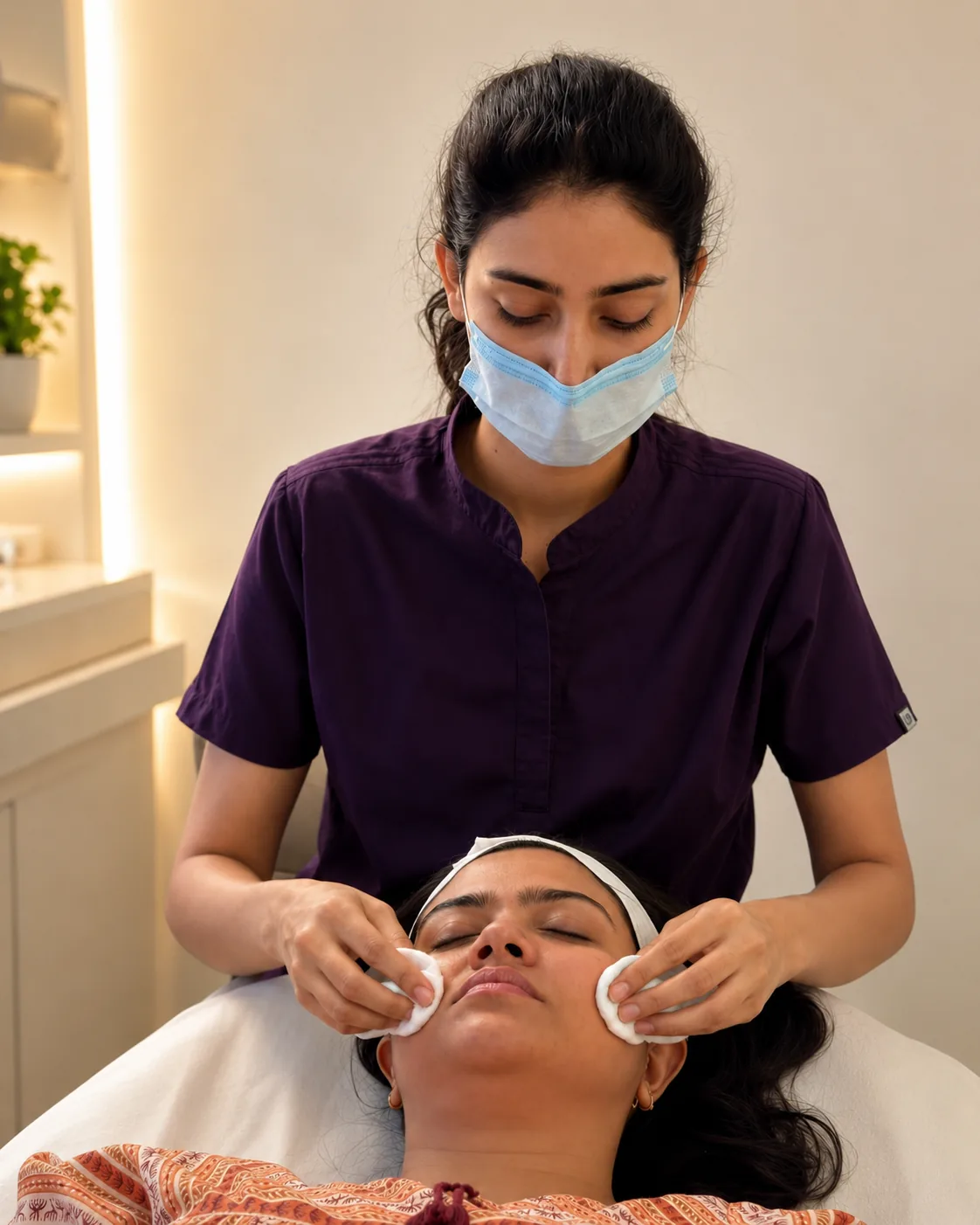
- Numbing cream for 30–45 minutes; the session itself takes 20–40 minutes
- A seven-day rule — no RF needling within a week of any laser or high-heat treatment
- Clients on blood thinners are limited by our constraints to gentle treatment; needling is discussed with the doctor and often deferred
- The infusion chosen for the goal, then a calming, barrier-supporting finish and sunscreen
Acne scar treatment — how RF needling is sequenced with peels →
Needling and Jaipur conditions
- The first 48 hours decide the result on Indian skin. Sun on freshly needled skin is the main cause of darkening; dust and sweat are the main causes of irritation. Plan sessions so you can stay indoors, cool and clean for two days — not before a desert trip or a day on a two-wheeler.
- Monsoon humidity is comfortable for healing but raises infection risk if the face cannot be kept clean; we advise against needling on days you cannot control that.
- October to February is the ideal needling season for most clients: lower UV, cooler air, and results ready by spring.
- Hard water on freshly needled skin can sting and irritate; use boiled-and-cooled or filtered water to cleanse for the first few days.
- Scalp needling for hair in summer means sweat on open channels — sessions are scheduled early in the day and clients avoid the gym for 24 hours.
Who should not have microneedling or RF microneedling
- Pregnancy and breastfeeding — energy devices are excluded in pregnancy, and needling is deferred in both
- Active acne, infection, cold sores or open wounds in the area — needling spreads infection
- Isotretinoin in the past six months — healing is impaired
- Keloid or hypertrophic scar tendency
- Anticoagulants or bleeding disorders — bruising and bleeding risk; our constraints limit such clients to gentle treatment
- Autoimmune skin conditions in flare, or uncontrolled diabetes, where healing is unpredictable
- For the RF version additionally: pacemakers or electronic implants, and metal implants in the treatment area
- A fresh tan or sunburn, or any laser or high-heat treatment in the past seven days
What to expect
Under numbing, plain needling feels like light sandpaper and RF needling like brief warm pinpricks; both are tolerable. Afterwards: a sunburn-like redness and mild swelling for one to three days, faint grid marks after RF for a day, and a tight, dry surface for up to a week that moisturiser and sunscreen manage. Texture looks smoother and brighter within two weeks as the surface renews; scar and pore improvement builds over the series and continues for three to six months after it as collagen matures. Photographs at each visit track the change. Results vary from person to person; deep scarring improves rather than disappears.
Where we use Microneedling & RF Microneedling at AI Aesthetics
The treatments at our C-Scheme clinic that actually include it — each page explains the full protocol, suitability and price.
Microneedling and RF microneedling: frequently asked questions
What is the difference between microneedling and RF microneedling?
Plain microneedling creates mechanical micro-channels that trigger collagen induction. RF microneedling adds radiofrequency heat delivered through the needle tips into the dermis, producing a stronger remodelling signal for pitted scars, pores and early laxity while the surface is spared.
Is RF microneedling safe for dark or Indian skin?
It is the scar treatment of choice for skin types IV and V precisely because insulated needles heat the dermis without heating the pigmented surface, avoiding the darkening risk of ablative lasers. Strict sun avoidance for 48 hours remains essential.
Why do you needle at 1.5 mm?
At 1.5 mm the needles reach the upper and mid dermis where scarring and texture problems sit, with manageable downtime. Shallower depths only deliver product; deeper depths add bleeding and pigment risk on the face without proportionate benefit.
Does microneedling hurt?
Numbing cream is applied for 30–45 minutes first. Plain needling feels like light sandpaper; RF needling like brief warm pinpricks. Both are well tolerated.
How many sessions are needed for acne scars?
Typically three to four RF microneedling sessions, four to six weeks apart, with improvement continuing for months afterwards. Deep ice-pick scars may need additional techniques within the plan.
What do you apply after needling?
Depending on the protocol: your own platelet-rich plasma, PDRN, exosomes or hyaluronic acid — all absorbed far deeper through the open channels than skin would normally allow.
Can I have needling if I have active acne?
No. Active acne, infection or cold sores in the area are treated first; needling over them spreads infection and worsens scarring.
What is the downtime?
Redness and mild swelling for one to three days, faint grid marks after RF for a day, and a dry, tight surface for up to a week. Two days indoors, cool and clean, are the key to a good result in Jaipur.
Can microneedling be done on the scalp?
Yes — plain microneedling is used on the scalp before PRP, GFC or exosome application in our hair programmes, to deliver them to the follicle environment.
Who should avoid microneedling?
Pregnant or breastfeeding clients, anyone with active acne or infection in the area, recent isotretinoin, keloid tendency, anticoagulant use or bleeding disorders, autoimmune flares, uncontrolled diabetes, a fresh tan, or a laser in the past week; for RF, also pacemakers and metal implants in the area.