Tranexamic Acid: The Melasma Active Explained — Mechanism, Routes and Cautions
Tranexamic acid was never meant for skin. It is a medicine for bleeding — used in surgery, trauma and heavy periods — and its arrival in dermatology was an accident: a Japanese physician in the 1970s noticed that patients taking it for other reasons saw their melasma fade. Fifty years on, it is one of the few actives with genuinely strong evidence for melasma, and the one we reach for most often when pigmentation is patchy, hormonal and sun-driven — the Jaipur pattern. This page explains the mechanism, the three routes it can be given by, how we use it, and the clotting history that rules some people out.
Content verified by Dr. Aakriti Mehra
4.9 · 30 Google reviews




What tranexamic acid is
Chemically, tranexamic acid is a small synthetic molecule built to look like the amino acid lysine. That resemblance is its whole trick. Many enzymes in the body dock onto proteins by grabbing a lysine; tranexamic acid occupies those docking sites first and blocks them. In blood, the enzyme it blocks is plasmin — the protein that dissolves clots — which is why surgeons use it to reduce bleeding. In skin, the same block interrupts a chain of events that connects sunlight to pigment.
At a glance
| Property | Detail |
|---|---|
| Chemical name | trans-4-(aminomethyl)cyclohexanecarboxylic acid |
| Molecular formula | C8H15NO2 |
| Molecular mass | ≈ 157 g/mol |
| Class | Synthetic lysine analogue; antifibrinolytic |
| Established medical use | Reduces bleeding in surgery, trauma and heavy menstrual periods |
| Dermatology routes | Oral (prescription), topical 2–5%, intradermal / microneedled, and infusion after hydradermabrasion |
| Best-evidenced indication | Melasma — multiple controlled trials for the oral route |
The mechanism: cutting the wire between sun and pigment
When UV light hits skin, the surface cells — keratinocytes — release an enzyme called plasminogen activator. That converts plasminogen in the tissue into plasmin, and plasmin does two things that melanocytes respond to: it frees arachidonic acid, which becomes prostaglandins that stimulate pigment production, and it releases growth factors (bFGF, VEGF) that both activate melanocytes and promote the fine, dilated blood vessels that give melasma its slightly reddish, flushed base. Tranexamic acid sits in the lysine-binding sites on plasminogen and stops this conversion. Less plasmin means fewer prostaglandins, fewer vascular growth signals and quieter melanocytes — without bleaching anything and without touching tyrosinase directly.
This is why it works where tyrosinase inhibitors such as kojic acid and arbutin only partly help: melasma is not just over-production of pigment, it is a UV-and-hormone-driven inflammatory and vascular process, and tranexamic acid acts on that process upstream. It also explains the characteristic pattern of response — gradual fading over two to three months, with the vascular, blotchy quality of the patches often improving first.
Kojic acid — the copper-chelating tyrosinase inhibitor it pairs with →
Three routes, three very different risk profiles
| Route | How it is given | Evidence | Main caution |
|---|---|---|---|
| Oral | Low-dose tablets, prescribed by a doctor, typically for 8–12 weeks | Strongest — several randomised trials show meaningful melasma improvement | Systemic: clotting risk; needs medical screening and a doctor’s prescription |
| Topical | 2–5% in serums and creams, applied daily | Moderate — consistent but smaller effect, slower | Minimal; mild irritation in some |
| Infusion / intradermal | Driven into the upper skin after hydradermabrasion or microneedling in clinic | Growing — studies of intradermal and microneedled delivery show results between topical and oral | Procedure-related only; no systemic absorption of note |
At AI Aesthetics the oral route is a medical decision taken by Dr. Aakriti Mehra after reviewing your history — it is not on the facial menu and not something the engine can select. The infusion and topical routes are what we use in clinic and recommend for home care, and they deliver tranexamic acid to the skin without the clotting question that the tablets raise.
How we use tranexamic acid at AI Aesthetics
As a jet or ultrasound infusion
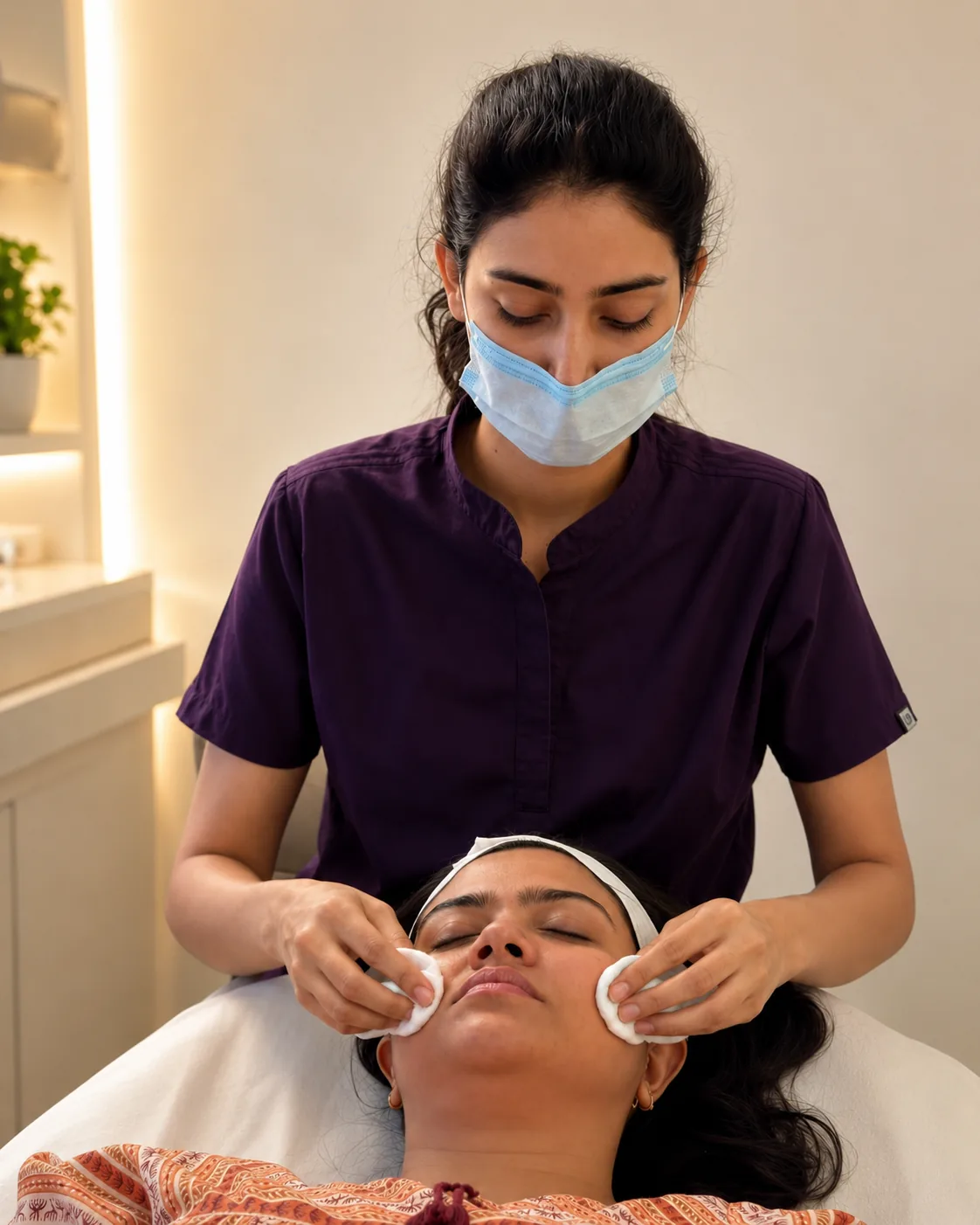
Tranexamic acid is one of the named infusion solutions in our hydradermabrasion system. After exfoliation and extraction have cleared the surface, it is driven into the upper skin with the ultrasound probe, concentrated on the pigmented zones — the cheeks, upper lip and forehead in a typical melasma pattern, rather than the whole face uniformly. The AI Customized Facial engine selects it when the scan flags patchy pigmentation, melasma tendency or post-acne marks as a priority. It is frequently the secondary corrective in a stacked session, following a brightening peel or a low-energy laser pass.
How the hydradermabrasion infusion step works →
In home-care brightening serums
Between visits, a serum combining tranexamic acid with kojic acid and alpha-arbutin is the maintenance backbone of most of our pigmentation plans — three different mechanisms, one application, used at night under a moisturiser and always with morning sunscreen. The plan is written for you after assessment; the exact product is not the point, the combination of mechanisms is.
Arbutin — the gentler tyrosinase inhibitor in the same serum →
Beyond the face
The same mechanism applies to pigmentation on the neck, back and intimate areas, where friction and hormonal factors add to sun. Tranexamic acid infusion and topical use are part of those protocols too, with peels chosen for the thicker skin of the body.
What Jaipur clients should know
- Melasma in Jaipur is a sun disease first. Tranexamic acid quiets the pathway; sunscreen stops it being switched on. Without daily, reapplied broad-spectrum protection, every rupee spent on tranexamic acid is being undone by the afternoon.
- Thyroid and melasma travel together. Our treatment constraints specifically ask the engine to look for a thyroid link when melasma is present and to set expectations accordingly — if yours is undiagnosed or poorly controlled, the pigmentation will keep returning. A thyroid test is often the most useful first step.
- Pregnancy, contraception and hormonal therapy drive the same pathway. Tranexamic acid is deferred in pregnancy, and the oral route is discussed carefully with anyone on hormonal contraception because of the combined clotting risk.
- Heat and friction matter on the body. Pigmentation on the neck, underarms and inner thighs is worsened by sweat and rubbing in summer; tranexamic acid helps the pigment component, but the friction has to be addressed too.
- Patience is built in. Expect the first visible change at six to eight weeks and the full effect of a plan at three months, maintained afterwards. Anyone promising melasma clearance in two sessions is not describing tranexamic acid.
Who should not have tranexamic acid
For the topical and infusion routes used in clinic, cautions are few: a known allergy, and open or infected skin in the treatment area. The list below applies above all to the oral route, and we ask about every item before any pigmentation plan, because we would rather know:
- Any history of deep vein thrombosis, pulmonary embolism, stroke or heart attack — tranexamic acid promotes clotting and is contraindicated
- Known clotting disorders or a strong family history of clots
- Current hormonal contraception or hormone replacement therapy — the combined clotting risk means the oral route is usually avoided
- Pregnancy and breastfeeding — deferred in all routes
- Significant kidney disease, which slows its clearance
- Clients on anticoagulants — the two work against each other; our constraints already limit such clients to gentle treatment, and tranexamic acid is not combined
- A history of seizures, for the oral route
What to expect
From infusion: no downtime and no immediate visible change — this is a cumulative active. Over a monthly series, with the home serum and sunscreen in place, the patches soften and the blotchy, reddish quality fades first, followed by gradual lightening over two to three months. Melasma is a relapsing condition; the goal is control and maintenance, not a one-time cure, and we photograph at every visit so that the trend, not the mirror, tells us how it is going. Results vary from person to person.
The Q-switched laser — when toning is added to a melasma plan, and its limits →
Where we use Tranexamic Acid at AI Aesthetics
The treatments at our C-Scheme clinic that actually include it — each page explains the full protocol, suitability and price.
Tranexamic acid: frequently asked questions
What is tranexamic acid and why is it used for skin?
A synthetic molecule that mimics the amino acid lysine and blocks the enzyme plasmin. In skin, that interrupts the pathway by which UV light stimulates pigment cells and the fine blood vessels of melasma. It was a bleeding medicine first and became a pigmentation active by observation.
How does tranexamic acid treat melasma?
By stopping plasminogen from becoming plasmin after sun exposure, it reduces the prostaglandins and growth factors that activate melanocytes and dilate vessels. It acts upstream of pigment production rather than bleaching existing pigment.
Do you give tranexamic acid tablets?
Oral tranexamic acid is a prescription decision made by Dr. Aakriti Mehra after a medical history, because it carries a clotting risk. In clinic we use the infusion and topical routes, which deliver it to the skin without that systemic concern.
Is tranexamic acid in your facials?
Yes — it is one of the named infusion solutions in our hydradermabrasion system, selected by the AI Customized Facial engine when the scan shows patchy pigmentation or melasma tendency, and concentrated on the pigmented zones.
How long does tranexamic acid take to work?
First visible softening at six to eight weeks; the full effect of a plan at around three months, then maintenance. It is cumulative and works only with consistent sun protection.
Who cannot use tranexamic acid?
Anyone with a history of clots, stroke or heart attack, a clotting disorder, significant kidney disease, or who is pregnant or breastfeeding. The oral route is also usually avoided with hormonal contraception. These matter most for tablets; topical and infusion use has few cautions beyond allergy.
Can I use tranexamic acid with vitamin C or niacinamide?
Yes. They act on different parts of the pigment process and are commonly combined. Our home-care serums pair tranexamic acid with kojic acid and arbutin for the same reason.
Does tranexamic acid lighten normal skin colour?
No. It reduces the abnormal, UV- and hormone-driven over-production of pigment in melasma and dark patches. It does not change your baseline skin tone.
Why does the clinic ask about my thyroid for melasma?
Thyroid disorders are linked to melasma, and our treatment constraints require the engine to consider that link when setting expectations. Untreated thyroid disease makes melasma harder to control with any active.
Is tranexamic acid safe in pregnancy?
It is deferred in pregnancy and breastfeeding. Melasma that appears in pregnancy is usually managed with sun protection and gentle care until afterwards.