Hyaluronic Acid: What It Is, Why Molecular Weight Matters, and How We Use It
Hyaluronic acid is in more products than any other active in skincare, and it is also the one most often used wrongly in a city like Jaipur. The molecule itself is simple to explain — it is a sugar that holds water — but what it does for your skin depends entirely on how big the molecules are and how they are delivered, which is why the same name covers a serum, a facial infusion, a skin booster and a dermal filler that behave nothing alike. This page explains that, how we use each form at AI Aesthetics, the dry-air mistake to avoid, and who should not have the injectable forms.
Content verified by Dr. Aakriti Mehra
4.9 · 30 Google reviews





What hyaluronic acid is
Hyaluronic acid — hyaluronan, or sodium hyaluronate in its salt form — is a long, unbranched chain of two alternating sugars, glucuronic acid and N-acetylglucosamine, repeated thousands of times. It is not a protein and not an acid in the exfoliating sense; the name is a chemical formality, and it does not sting. Your own body makes it continuously: about half of all the hyaluronic acid in you is in the skin, sitting in the dermis between collagen and elastin fibres, where its job is to hold water. Each molecule can bind many hundreds of times its own weight, which is what gives young skin its plump, hydrated resilience.
Two things happen with age and sun. The skin makes less of it, and it breaks the existing chains down faster. By the forties, dermal hyaluronic acid is a fraction of what it was at twenty, and the dermis is literally drier — which reads as fine lines, dullness and a loss of bounce long before any real sagging.
At a glance
| Property | Detail |
|---|---|
| Class | Glycosaminoglycan — a linear polysaccharide |
| Repeating unit | Glucuronic acid + N-acetylglucosamine |
| Molecular weight | From a few thousand Da (fragments) to several million Da (native) |
| Water binding | Up to ≈1,000× its weight |
| Half-life in skin | Less than a day — constantly made and broken down |
| Forms used in aesthetics | Topical serums, infusion solutions, non-cross-linked injectable (skin boosters), cross-linked gel (dermal fillers) |
Why molecular weight decides everything
Native hyaluronic acid is enormous — far too large to pass through intact skin. So the industry chops it into different sizes, and each size does a different job.
| Size | Where it goes | What it does | Caveat |
|---|---|---|---|
| High molecular weight (> 1,000 kDa) | Stays on the surface | Forms a breathable, water-holding film; immediate smoothing and comfort | Washes off; no change below the surface |
| Medium (100–1,000 kDa) | Upper epidermis | Hydrates the surface layers; the usual ‘serum’ range | Effect lasts hours to a day |
| Low (< 100 kDa) | Deeper into the epidermis | Hydrates where the skin feels tight; can support barrier repair | Very small fragments can be mildly pro-inflammatory on compromised skin |
| Cross-linked gel (injectable) | Dermis, by injection | Physically restores volume and holds water for months | A medical procedure with its own risks |
A good formulation uses several sizes together — film on top, hydration below. A facial infusion uses a size chosen to penetrate skin that has just been exfoliated and is being driven by pressure or ultrasound, which is why an infusion step delivers more than a serum applied at home.
The dry-air mistake — Jaipur’s specific problem
Hyaluronic acid is a humectant: it pulls water towards itself. In humid air it draws moisture from the atmosphere onto your skin. In dry air — a Jaipur afternoon in April at under 20% humidity, or an air-conditioned office in any month — there is little moisture in the air to pull, so a humectant applied to dry skin can draw water upward from the deeper layers and let it evaporate. Clients come in saying hyaluronic acid makes their skin feel tighter, and in this climate they are not imagining it.
The fix is simple and we repeat it in every consultation: apply hyaluronic acid to damp skin, not dry, and seal it immediately with a moisturiser that contains occlusive or barrier lipids — ceramides, squalane, shea. Give it water to hold, and a lid to hold it under. In the monsoon months this matters less; from October to June it is the difference between the ingredient helping and hurting.
Barrier repair treatment — when dry skin needs more than hydration →
How we use hyaluronic acid at AI Aesthetics
As a facial infusion
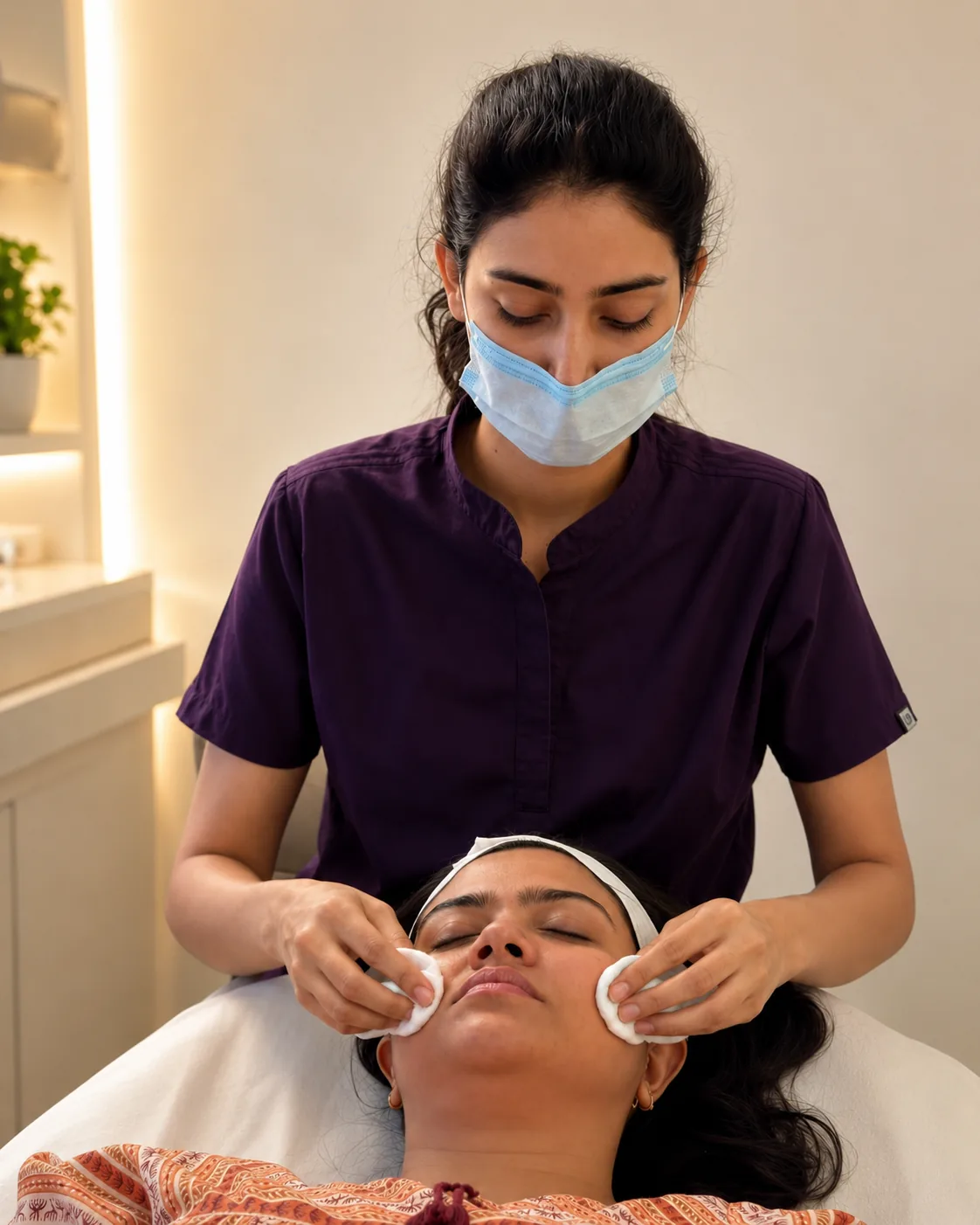
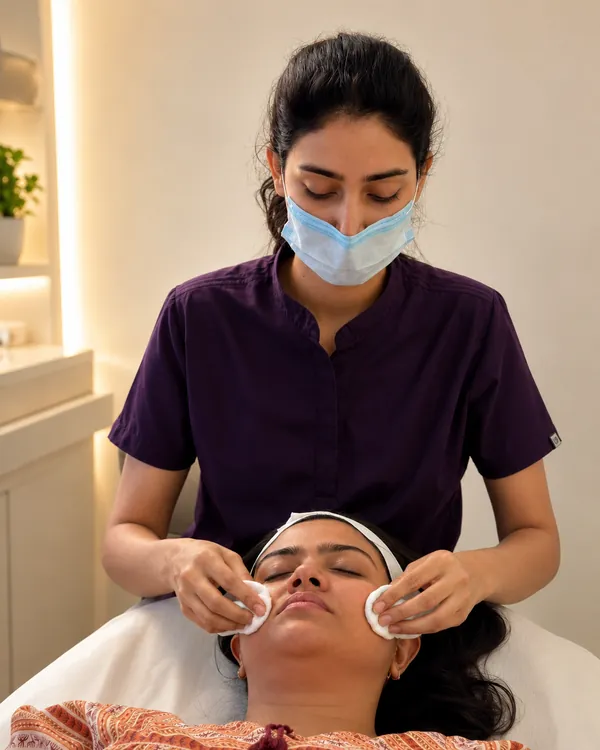
After hydradermabrasion has exfoliated and cleared the surface, a hyaluronic acid solution is infused with the oxygen spray or ultrasound probe. The AI Customized Facial engine selects it whenever the scan shows a low hydration signal, fine dehydration lines or the tight-but-oily pattern that our skin report found in three out of four clients. It is the most frequently chosen infusion for the post-travel and sensitive-skin recovery facials, often paired with PDRN.
HydraFacial in Jaipur — the hydration infusion step →
As a skin booster
Skin boosters place a non-cross-linked, free-flowing hyaluronic acid into the dermis through many tiny injections or microneedling, where it stays for weeks rather than hours and hydrates from within. It does not add volume or change shape; it changes skin quality — hydration, fine lines, glow — over a short series. The doctor performs or supervises this route.
Skin boosters in Jaipur — hyaluronic, PDRN and exosome options →
As a dermal filler
Cross-linking bonds hyaluronic acid chains into a gel that resists breakdown and holds its shape. Injected by a doctor into specific planes of the face, it restores lost volume, defines the jawline or chin, or softens deep folds, and lasts many months before the body gradually dissolves it. It is a medical procedure performed only by Dr. Aakriti Mehra on her Jaipur visit days, with its own consultation; the hydration-type uses above do not require it.
Dermal fillers in Jaipur — doctor-performed, by appointment →
Who should avoid hyaluronic acid
Topical and infused hyaluronic acid is among the safest actives in skincare — allergy is rare, it is non-comedogenic and it is appropriate in pregnancy, in our pregnancy-safe facial protocol included. The cautions apply to the injectable forms:
- Pregnancy and breastfeeding — skin boosters and fillers are deferred
- Active infection, cold sores or acne in the injection area
- Autoimmune conditions in flare, or a history of granulomatous reactions to injectables
- Blood thinners or bleeding disorders — bruising risk is higher; our constraints already limit such clients to gentler treatment, and injectables are discussed with the doctor
- Previous permanent or unknown fillers in the same area
- Keloid tendency, for the microneedling route of skin boosters
- Unrealistic expectations — a filler changes volume, not skin texture; a booster changes texture, not shape. We match the form to the goal, and say no when it does not fit
What to expect
Infusion: immediately plumper, smoother, more comfortable skin, peaking over two to three days and fading over a few weeks — the reason monthly sessions suit dehydration-prone skin. Skin boosters: small bumps for a day, then a gradual improvement in hydration and fine lines over two to three sessions a month apart, lasting several months. Fillers: visible immediately, settled by two weeks, lasting many months, with bruising possible for a few days. None of these replaces daily moisturiser and sunscreen — in Jaipur’s air, the hyaluronic acid we put into your skin needs the same lid as the serum you apply at home. Results vary from person to person.
Where we use Hyaluronic Acid at AI Aesthetics
The treatments at our C-Scheme clinic that actually include it — each page explains the full protocol, suitability and price.
Hyaluronic acid: frequently asked questions
What does hyaluronic acid do for skin?
It binds and holds water in the skin — up to a thousand times its own weight. Topically and by infusion it hydrates and plumps the surface layers; as a skin booster it hydrates the dermis for weeks; as a cross-linked filler it restores volume for months.
Why does hyaluronic acid make my skin feel tight in Jaipur?
In dry air a humectant can draw water up from deeper skin and let it evaporate. Apply it to damp skin and seal it with a moisturiser containing barrier lipids; from October to June this step is essential.
What is the difference between a hyaluronic acid serum, a skin booster and a filler?
A serum hydrates the surface for hours. A skin booster is non-cross-linked hyaluronic acid placed in the dermis to improve skin quality over weeks. A filler is a cross-linked gel injected to restore volume and shape for months. Same molecule, three different products.
Does molecular weight matter?
Yes — it decides where the molecule goes. Large molecules sit on the surface as a hydrating film; smaller ones penetrate the upper skin layers. Good products and our infusions use sizes chosen for the job.
Is hyaluronic acid safe in pregnancy?
Topical and infused hyaluronic acid is appropriate in pregnancy and is part of our pregnancy-safe hydradermabrasion facial. Injectable boosters and fillers are deferred.
How long does a hyaluronic acid infusion last?
The plumping effect peaks over two to three days and fades over a few weeks, which is why dehydration-prone clients book monthly.
Does hyaluronic acid cause breakouts?
No. It is non-comedogenic and suits oily, acne-prone skin, which is often also dehydrated.
Who performs hyaluronic acid fillers at AI Aesthetics?
Dermal fillers are a medical procedure performed only by Dr. Aakriti Mehra on her Jaipur visit days, after a dedicated consultation.
Can hyaluronic acid replace moisturiser?
No. It holds water; a moisturiser with barrier lipids stops that water leaving. In Jaipur’s dry air you need both, in that order.
Which facials at AI Aesthetics use hyaluronic acid infusion?
HydraFacial, the AI Customized Facial when the scan shows low hydration, and the post-travel and sensitive-skin recovery facials, often paired with PDRN.