Microdermabrasion: Diamond and Crystal Exfoliation, and Where It Still Belongs
Microdermabrasion is the exfoliation technology hydradermabrasion was invented to improve on, and it is still in our clinic for a reason. Where the newer system exfoliates with fluid and suction, microdermabrasion does it the old way — by physically abrading the outermost layer with a diamond-coated tip or a stream of fine crystals, and vacuuming the debris away. On the thin, reactive skin of a Jaipur face that is usually the wrong tool; on the thick, rough skin of a neck, a back or an elbow it is often the right one. This page explains how it works, the two tip types, where the treatment engine still chooses it, and the rules that keep it safe on darker skin.
Content verified by Dr. Aakriti Mehra
4.9 · 30 Google reviews



How it works
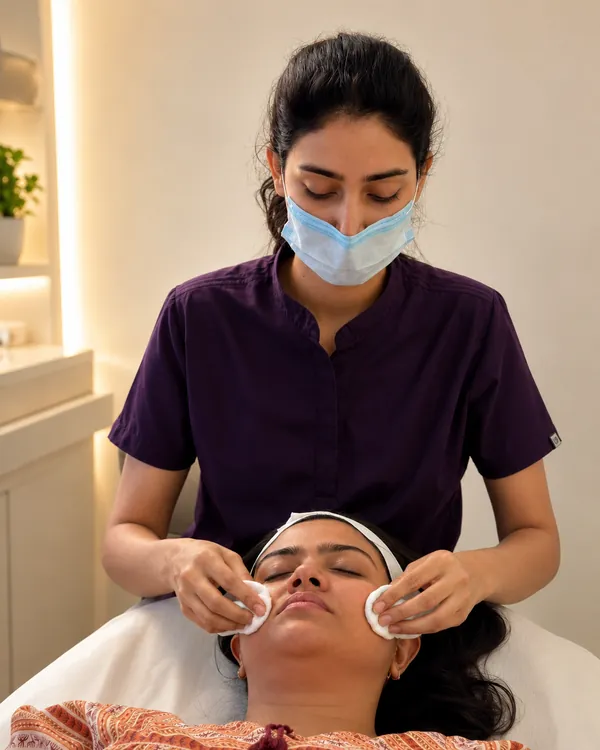
The skin’s outermost layer, the stratum corneum, is a sheet of dead, flattened cells that thickens with sun, friction and age into the rough, dull surface people describe as “leathery” or “sandpapery”. Microdermabrasion removes part of that layer mechanically. A handpiece is passed across the skin under vacuum: the suction pulls the surface taut against an abrasive, the abrasive planes off the top cells, and the same suction draws the debris into a filter. Two or three passes thin the dead layer evenly; the living epidermis beneath is stimulated, not removed, and responds over the following days with faster turnover and a smoother, brighter surface. Done repeatedly, the mild injury also encourages modest thickening of the dermis — the same logic as a light peel, achieved with friction rather than acid.
At a glance
Diamond tip versus crystal tip
| Diamond tip | Crystal tip | |
|---|---|---|
| How it abrades | A wand tipped with bonded diamond particles, in direct contact with the skin | A stream of fine aluminium-oxide crystals blasted against the skin and vacuumed away |
| Control | Precise — the therapist feels the pressure and chooses the grit | Less precise; intensity set by crystal flow and suction |
| Mess | None; no loose particles | Residual crystals must be fully removed; not used near the eyes |
| Best for | Face, delicate zones, sensitive or darker skin | Thick, rough body skin — back, elbows, knees; stubborn tan |
| Our default | Yes, for any facial use | Reserved for body and thick-skin cases |
On the face we use the diamond tip almost exclusively; it gives the therapist tactile control that matters on Indian skin, where over-abrasion means darkening. The crystal tip earns its place on body skin that laughs at a diamond wand.
Where microdermabrasion still wins
- Thick, rough skin: the neck, upper back, elbows and knees, where tan and keratin build-up make the surface coarse and hydradermabrasion’s fluid exfoliation is too gentle
- Acid-intolerant clients: people who react to every peel can often tolerate a mechanical exfoliation with no chemicals at all
- Body de-tan and pigmentation prep: a diamond or crystal pass before a body peel evens the surface so the peel acts uniformly
- Rough, bumpy texture on the arms (the sandpaper feel of keratosis-type roughness), where friction works better than fluid
- Immediate smoothness before an event, on skin that is thick enough to take it
Where hydradermabrasion replaced it
For most faces, most of the time, the hydradermabrasion system does the exfoliating job with less trauma and adds extraction, infusion and cooling in the same pass. Reactive, dehydrated, acne-prone or sensitive facial skin — which in Jaipur is the majority — belongs on that machine. Our treatment engine chooses microdermabrasion for the face only when thick, rough texture is the specific problem and the barrier scores allow a mechanical pass; it never selects it by habit.
The hydradermabrasion system — the fluid-exfoliation alternative →
The rules that keep it safe on darker skin
Microdermabrasion counts as exfoliation in our treatment-planning constraints, and the rules written for exfoliation apply to it without exception:
- Retinol in the past 24 hours blocks aggressive exfoliation — the mechanical pass is skipped or softened
- Clients on blood thinners are limited to gentle exfoliation only, so the crystal tip and heavy diamond passes are out
- A barrier the scan shows as compromised — flaking, strong redness, very low hydration — rules out abrasion that day
- More than two hours of daily sun exposure removes medium-depth exfoliation from the plan, and freshly tanned skin is never abraded
- Every session still ends with serum, moisturiser and sunscreen, which after abrasion is not optional
Microdermabrasion and Jaipur conditions
- Dust and sun thicken the surface on the neck and forearms faster than on the face; a monthly diamond pass on those areas does more than any serum.
- Post-summer tan on the back and shoulders before the wedding season responds to crystal microdermabrasion followed by a body peel — but only once the sun exposure has actually stopped.
- Dry winters: abrasion on December skin needs heavier moisturising afterwards; the engine pairs it with hyaluronic acid or skips it for a hydrating alternative.
- Hot months on the face: we avoid it — heat-stressed, red skin plus abrasion is how pigmentation starts.
- Hard water irritates freshly abraded skin; cleanse gently with filtered water for two days.
Who should not have microdermabrasion
- Active acne, pustules or infection — abrasion spreads it and worsens scarring
- Rosacea, eczema, psoriasis or any inflammatory condition in flare
- Open wounds, cold sores or recent sunburn
- Isotretinoin in the past six months
- Keloid tendency, or a history of darkening after minor skin trauma
- Blood thinners, for anything beyond a gentle pass
- Within a week of a peel, laser or microneedling
What to expect
A scratching, pulling sensation as the wand moves — not painful — for fifteen to thirty minutes depending on the area. Pinkness for a few hours, a smoother, more even surface immediately, and brighter skin over the following days as the thinned layer renews. Mild dryness for a day or two is normal. Texture and tan on body skin improve across a monthly series; on the face the benefit is immediate smoothness rather than lasting change, which is why it sits inside a broader plan. Results vary from person to person.
Where we use Microdermabrasion at AI Aesthetics
The treatments at our C-Scheme clinic that actually include it — each page explains the full protocol, suitability and price.
Microdermabrasion: frequently asked questions
What is microdermabrasion?
A mechanical exfoliation that planes off part of the dead outer skin layer with a diamond-coated tip or a crystal stream while vacuum removes the debris. It smooths rough texture and brightens dull skin without chemicals.
Diamond or crystal — which is better?
Diamond for the face and any sensitive or darker skin, because the therapist controls pressure precisely and there are no loose particles. Crystal for thick body skin such as the back, elbows and knees.
Microdermabrasion or hydradermabrasion?
Hydradermabrasion for most faces — gentler, with extraction and infusion built in. Microdermabrasion for thick, rough skin, body de-tan prep, and clients who cannot tolerate acids. Our engine chooses by skin, not habit.
Is microdermabrasion safe for dark skin?
With the diamond tip, light pressure and strict sun protection afterwards, yes. Over-abrasion or sun on freshly treated skin can cause darkening, which is why our exfoliation rules — retinol, sun exposure, barrier scores — apply to it.
Does microdermabrasion hurt?
No — a scratching, pulling sensation. Pinkness lasts a few hours and mild dryness a day or two.
Can I have microdermabrasion if I have acne?
Not during active breakouts; abrasion spreads infection and worsens scarring. Acne is controlled first, and the engine uses salicylic steps or the carbon facial instead.
Is microdermabrasion good for tan removal?
On body skin — back, shoulders, arms — a crystal or diamond pass followed by a body peel is effective once sun exposure has stopped. On the face we prefer gentler de-tan routes.
How often can I have microdermabrasion?
Monthly for texture on body areas; on the face it is used selectively within a plan rather than as a routine.
Why was my microdermabrasion changed to a gentle pass?
Our constraints limit clients on blood thinners to gentle exfoliation, skip aggressive exfoliation within 24 hours of retinol, and rule out abrasion when the scan shows a compromised barrier or recent sun exposure.
Does microdermabrasion remove scars or pigmentation?
No. It smooths surface roughness and brightens; pitted scars need RF microneedling and pigmentation needs peels, brighteners and sun protection.