Multi-Wavelength Diode Laser: How Laser Hair Removal Actually Works
Every laser hair removal clinic says its machine is the latest and the safest. Almost none explain what the machine does. This page does: what a diode laser is, what “multi-wavelength” means and why it matters more for Indian skin than for European skin, why we run the laser in a gliding low-energy mode rather than firing single shots, what the numbers on our machine mean, and the rules our clinic applies before the handpiece ever touches you.
Content verified by Dr. Aakriti Mehra
4.9 · 30 Google reviews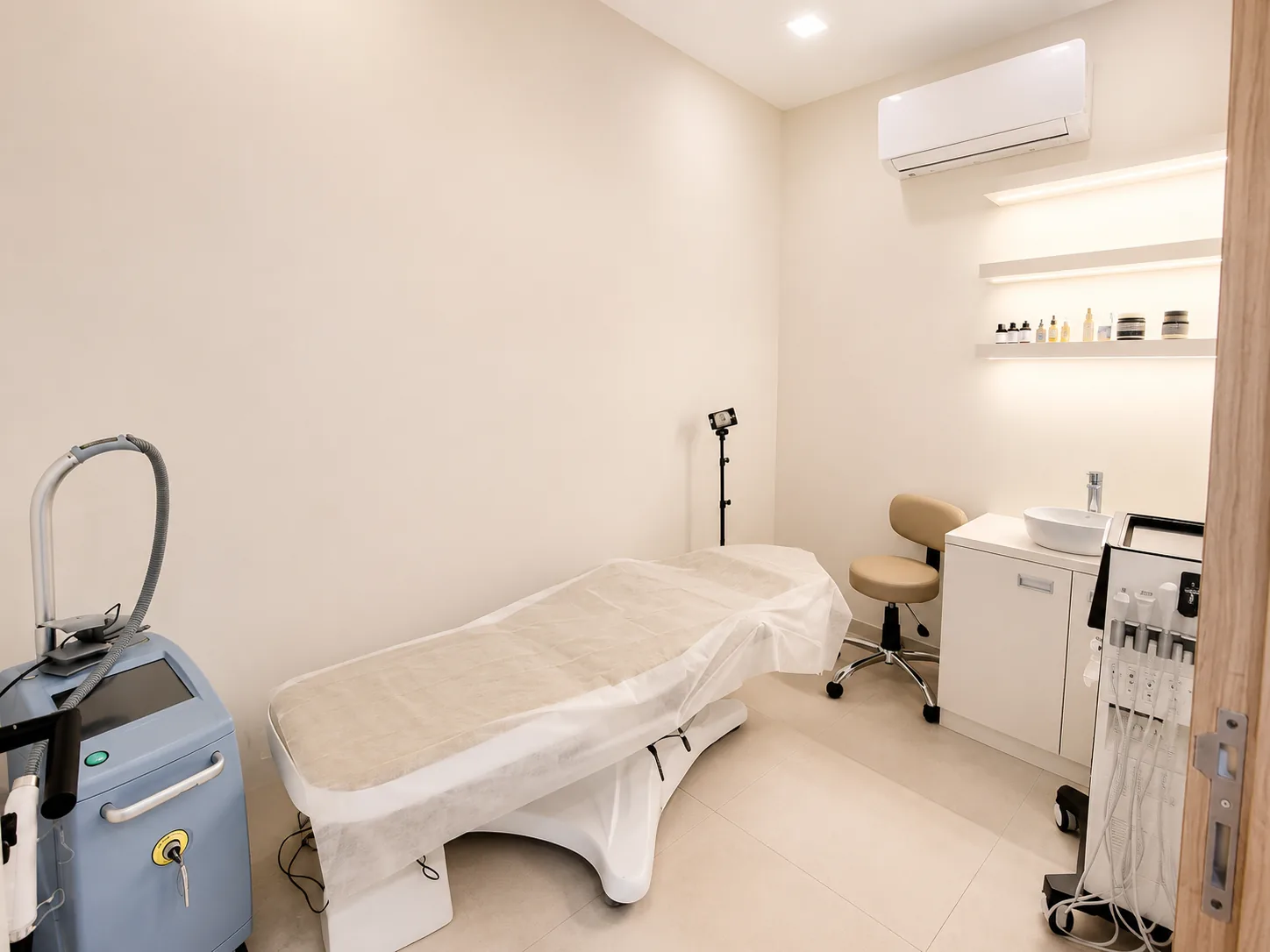

The principle: heat the hair, spare the skin
Laser hair removal rests on one idea, formalised in 1983 and called selective photothermolysis: choose a wavelength of light that is absorbed far more strongly by your target than by the tissue around it, deliver it in a pulse short enough that the heat has no time to spread, and the target is damaged while its surroundings are not. For hair, the target is melanin — the pigment in the hair shaft and in the cells at the base of the follicle. Light travels through the skin, is soaked up by the dark hair, turns into heat, and that heat cooks the follicle’s growth machinery.
The complication, and the whole reason wavelength matters, is that skin also contains melanin. On very fair skin the hair is the only dark thing in the path, so almost any red or near-infrared wavelength works. On Indian skin — most clients in Jaipur fall between Fitzpatrick types III and V — the epidermis competes for the light. Choose badly and the skin absorbs enough energy to burn, blister or leave dark marks that last longer than the hair would have.
What “multi-wavelength” means and why it matters here
A diode laser generates light from a semiconductor, which makes it efficient, compact and able to deliver high power continuously — the reason diode systems dominate hair removal. Older machines used a single wavelength, usually 808 nm. The system at AI Aesthetics emits three wavelengths from one handpiece, blended in each pulse: 755 nm, 808 nm and 1064 nm. Each behaves differently in skin.
| Wavelength | Melanin absorption | Depth | Best at | Risk on darker skin |
|---|---|---|---|---|
| 755 nm | High | Shallow | Fine, lighter, superficial hair; fair skin | Highest — epidermal melanin competes strongly |
| 808 nm | Moderate | Medium | The all-round workhorse for most hair and skin types | Moderate |
| 1064 nm | Low | Deep | Coarse, deep-rooted hair; darker and tanned skin | Lowest — passes the epidermis with least absorption |
Blending the three gives the physics of each in one pass: 755 nm catches the finer hair that 1064 nm would miss, 1064 nm reaches the deep coarse follicles of a beard or bikini line while sparing a type V epidermis, and 808 nm covers the middle. It also means the operator is not choosing between a “safe but weak” and a “strong but risky” machine — the balance is built into the pulse. For a clinic whose clients are overwhelmingly Indian skin tones, that is not a feature; it is the point.
In-motion, low-fluence mode versus single shots
There are two ways to deliver the energy. The traditional way fires a single high-energy pulse at each spot — effective, but each pulse is a sharp spike of heat, which is what hurts and what burns darker skin. The method we use instead is often called in-motion or super-hair-removal mode: the handpiece glides continuously over the area, firing many low-energy pulses per second — up to ten — so the follicle is warmed gradually to its damage threshold, around 45 °C, over several passes rather than hit once at a higher temperature.
Gradual heating has three consequences that matter to you. It is far more comfortable — most clients describe warmth, not snapping. It is safer on pigmented skin, because the epidermis is never pushed past its own threshold in any single pulse. And the heat builds in the follicle’s bulge region, where the stem cells that regrow hair live, which is the structure that actually needs to be disabled rather than just the visible shaft.
The numbers on our machine, translated
| Specification | Value | What it means for you |
|---|---|---|
| Wavelengths | 755 / 808 / 1064 nm blended | One pass covers fine, medium and deep hair; safe across Indian skin tones |
| Spot size | 15 × 28 mm | A large window: full legs or back are treated quickly, with even overlap |
| Peak power | 1000 W | Enough energy to run low-fluence in-motion mode fast without dropping effectiveness |
| Contact cooling | Chilled sapphire tip in constant skin contact | Protects the epidermis and takes the sting out of each pulse |
| Repetition | Up to 10 pulses per second | The basis of gradual, in-motion heating |
Why it takes six to eight sessions
Hair grows in cycles. Only follicles in the active growth phase — anagen — are connected to a pigmented, laser-reactive bulb; resting and shedding follicles are largely immune. At any moment only a fraction of the hair on a given area is in anagen, so one session can only disable that fraction. Sessions are spaced to catch successive cohorts as they enter growth: four to six weeks apart on the face, six to eight on the body. Across six to eight sessions, most clients see hair that is markedly sparser, finer and slower. Laser produces long-term hair reduction, not removal forever; hormonal hair in particular can return, which is why maintenance sessions exist.
How AI Aesthetics sets up a laser session
The machine is the same on every client; the settings are not. Before your first full session:
- A doctor-led suitability assessment — skin type, hair type, recent sun, medications, hormonal history
- A patch test, so your skin’s response to the chosen settings is known before a large area is treated
- A surface skin-temperature check: our protocol blocks heat-based devices when the facial surface reads 36.9 °C or above, and lowers intensity between 36.4 and 36.9 °C, because elevated surface temperature signals inflammation and higher reactivity
- A seven-day rule — if any laser or high-heat treatment was done in the past week, no laser is used in this session
- Settings chosen for your skin tone and hair thickness, then adjusted zone by zone: the upper lip is not treated like the lower leg
On the day: the area is cleansed and shaved if needed, cooling gel is applied, and the handpiece glides in overlapping passes. An upper lip takes minutes, full legs around forty. You can go back to your day immediately.
Jaipur-specific considerations
- Tan is the enemy of safe laser. A tanned epidermis absorbs more light and burns more easily. After a sunny day out, a trip, or Holi, we wait for the tan to settle before treating exposed areas; sunscreen on treated zones is not negotiable.
- Summer sweat and friction: inner thighs, underarms and bikini line are irritated by heat and sweat in May and June. Sessions still go ahead, but aftercare — loose clothing, no gym for a day — matters more.
- Dry winters: laser-treated skin is temporarily drier. Jaipur’s winter air makes that worse; a bland moisturiser for the week after is part of the plan.
- Wedding and festive season: hair cycles do not care about dates. For a wedding, a course that starts five to six months earlier finishes comfortably; one started six weeks before cannot.
- Hard water: not a laser issue directly, but it dries skin and can irritate freshly treated areas — a reason we specify a gentle cleanser for aftercare.
Who should not have diode laser hair removal
- White, grey, blonde or red hair — no melanin, no target; the laser cannot see it
- A fresh tan or active sunburn on the area
- Pregnancy — deferred as a precaution; the hormonal hair of pregnancy also tends to resolve on its own
- Isotretinoin in the past six months, or photosensitising medicines (some antibiotics, retinoids, certain antidepressants) — discussed case by case
- Active infection, cold sores, eczema or open skin in the area
- A history of keloid scarring, where any skin trauma is approached cautiously
- Untreated hormonal conditions driving hair growth — laser still works but expectations and maintenance must be planned honestly, and a medical review may be recommended
Face laser hair removal — hormonal and PCOS-related hair explained →
What this laser does not do
It does not remove hair permanently and forever — it produces long-term reduction, maintained with occasional sessions. It does not treat ingrown hairs or pigmentation on its own, though both usually improve when the shaving and waxing cycle stops. It is not the right tool for pigmentation, scars or skin tightening; those use different wavelengths and different devices, which have their own pages in this hub.
Q-switched laser — the pigmentation and carbon-facial laser →
Where we use Multi-Wavelength Diode Laser at AI Aesthetics
The treatments at our C-Scheme clinic that actually include it — each page explains the full protocol, suitability and price.
Diode laser hair removal: frequently asked questions
How does a diode laser remove hair?
It emits near-infrared light that is absorbed by the melanin in the hair and follicle far more than by the surrounding skin. The light becomes heat, which disables the follicle’s growth cells. Sessions are repeated to catch hair as it cycles into the growth phase.
What does multi-wavelength (755 / 808 / 1064 nm) mean?
Three wavelengths are blended in each pulse. 755 nm targets finer superficial hair, 1064 nm reaches deep coarse hair while passing safely through darker skin, and 808 nm covers the middle. Together they treat more hair types with less risk on Indian skin tones.
Is diode laser safe for dark or Indian skin?
With the right wavelength mix, in-motion low-fluence delivery, contact cooling and a patch test, it is well suited to Indian skin types III to V. No laser is risk-free; the safeguards are what make it appropriate, and our protocol includes all of them.
Does laser hair removal hurt?
In in-motion mode most clients describe a building warmth rather than sharp snaps. The upper lip and bikini line are the most sensitive zones; cooling and settings are adjusted to your comfort.
Why do I need 6 to 8 sessions?
Only hair in its active growth phase responds, and only a fraction of hair is in that phase at any time. Spaced sessions catch each new cohort. Most clients see sparser, finer, slower hair across the course.
Is laser hair removal permanent?
It gives long-term hair reduction, not permanent removal. Hair grows back finer and sparser; hormonal hair can return over time, which is why maintenance sessions are part of our packages.
Can I have laser if I am tanned?
Not on tanned areas. A tan raises the skin’s own light absorption and the burn risk. We wait for the tan to fade and ask for daily sunscreen on treated zones throughout the course.
Does laser work on grey or white hair?
No. Without melanin there is nothing for the laser to target. Electrolysis is the alternative for grey hair.
What is the spot size and why does it matter?
Our handpiece treats a 15 × 28 mm window per pulse. A large spot covers big areas quickly with even overlap, so full legs or a back take less time and have fewer missed patches.
What safety checks does AI Aesthetics do before laser?
A doctor-led assessment, a patch test, a surface skin-temperature reading that blocks heat devices above 36.9 °C, a check that no laser or high-heat treatment was done in the past seven days, and settings chosen for your skin tone and each treatment zone.