Activated Carbon: What the Carbon Lotion Does in a Carbon Facial
The carbon facial is usually explained as a laser treatment, and the laser gets the credit. In fact the laser is only half of it. The other half is a thin coat of black liquid carbon painted onto the face first — and what that carbon does before the laser ever fires is why the treatment works on oily, congested, dull skin the way nothing else quite does. This page is about the carbon: what it is, what it adsorbs, why it is the perfect target for a 1064 nm Q-switched pulse, and where it appears in our facials beyond the laser room.
Content verified by Dr. Aakriti Mehra
4.9 · 30 Google reviews


What activated carbon is
Activated carbon is ordinary carbon — from coconut shell, wood or other plant sources — that has been processed at high temperature to open up a vast network of microscopic pores. A single gram can have a surface area of several hundred square metres. That surface is what makes it useful: molecules of oil, grime and odour stick to it by adsorption, which is why activated carbon sits in water filters, gas masks and emergency rooms. The carbon lotion used in a carbon facial is micronised activated carbon suspended in a light liquid carrier so it can be painted onto skin and settle into pores.
At a glance
| Property | Detail |
|---|---|
| Material | Micronised activated carbon (elemental carbon) in a liquid or gel carrier |
| Key property | Enormous internal surface area — adsorbs sebum, debris and surface oxidation products |
| Optical property | Absorbs light across the spectrum, including the 1064 nm Q-switched wavelength |
| Forms used at the clinic | Liquid carbon lotion for the carbon facial; charcoal peel-off mask for oil control in facials |
| Downtime | None |
Step one: adsorption
Applied to cleansed skin and left for several minutes, the carbon lotion does what carbon does — it binds the sebum in the pores, the dead cells on the surface, and the film of sweat, sunscreen and pollution that a Jaipur day leaves behind. As it dries it also settles into the fine texture of the skin, so the layer is not sitting on top of the face but keyed into it. This is already a cleansing step, and it is why the treatment reads as a deep clean even before the laser.
Step two: the carbon as a target
A 1064 nm Q-switched laser passes through skin with relatively little absorption — that is the property that makes it safe on darker complexions. Pure carbon, by contrast, absorbs that wavelength almost completely. So when the laser is passed over a carbon-coated face, the energy is released exactly where the carbon is: on the surface and in the pore openings, not in the deeper skin. The nanosecond pulse heats each carbon particle so fast that it shatters with a soft crackle, and in shattering it takes with it the sebum and debris it had bonded to, along with the outermost layer of dead cells. That is the “laser peel” — a precise, surface-level exfoliation driven by a target you painted on, which is why the carbon facial is gentle enough for no downtime yet effective enough that the engine counts it as a real corrective.
A second, lower-energy pass without carbon then warms the dermis gently, which stimulates collagen and tightens the look of pores over a series.
The Q-switched laser — the physics of the nanosecond pulse →
Where the engine chooses the carbon facial
Our treatment-planning constraints give the carbon facial a specific and fairly privileged position. It is a valid energy-based hero corrective for active acne lesions — unlike the Q-switched laser used alone, which is barred for that purpose — and it must be compared head to head against the salicylic peels for acne, oil and congestion, against Fusion Peel-E and the Combination Peel for post-acne pigmentation, and against Glyco 35 for texture tied to pores. If it is allowed and expected to produce a stronger one-session visible result than those peels, it wins; if a peel wins instead, the engine must explain why. It also stacks well: the constraints list “Party Peel + carbon facial” and “Pumpkin Peel + carbon facial” as valid combinations for glow with pore refinement, and “Combination Peel + carbon facial” for mixed acne and pigmentation.
Salicylic acid — the peel family it competes with for acne →
The charcoal mask — carbon without the laser
Carbon also appears in our facials as a charcoal peel-off mask, one of the five mask types the engine can select. It uses the same adsorption to pull oil and surface debris from congested skin at the end of a cleansing sequence, and it is chosen for oil control and detox goals in oily and combination skin — including in the Express Clean-Up and in AI Customized Facials for clients who cannot have the laser that day. It is a milder, surface-only cousin of the carbon facial rather than a substitute for it.
Carbon and Jaipur skin
- The summer film — sweat, sunscreen, dust and sebum — is exactly what carbon adsorbs. Clients who work outdoors or on two-wheelers in May and June are the classic carbon facial cases.
- Monsoon congestion and small bumps along the jaw and hairline respond to the pore-clearing effect, usually with a salicylic spot step for any active lesions.
- Before an event: the carbon facial is one of the few treatments that gives a visibly matte, polished finish the same day with nothing to hide.
- The laser rules still govern it: more than two hours of daily sun, travel or an event within seven days, acids used yesterday, retinol in 24 hours, or any laser in the past week will postpone the carbon facial — the charcoal mask can stand in.
- Dry winter skin is not a carbon case. If your skin is tight and flaking, the engine will choose hydration first and leave carbon for the oily months.
Who should not have a carbon facial
- Everyone on the Q-switched laser exclusion list — pregnancy, fresh tan or sunburn, isotretinoin or photosensitising medicines, active infection or cold sores, keloid tendency, prior laser hypopigmentation
- Skin whose scan shows a compromised barrier — strong redness, flaking or very low hydration — where our constraints deny energy devices
- A facial surface temperature of 36.9 °C or more at the start of the session, which blocks heat-based devices
- Very dry, dehydrated skin without oil or congestion — there is little for the carbon to do and the exfoliation is unhelpful
- A known reaction to carbon or charcoal products, which is rare
The charcoal peel-off mask has almost none of these restrictions and is used where the laser cannot be.
What to expect
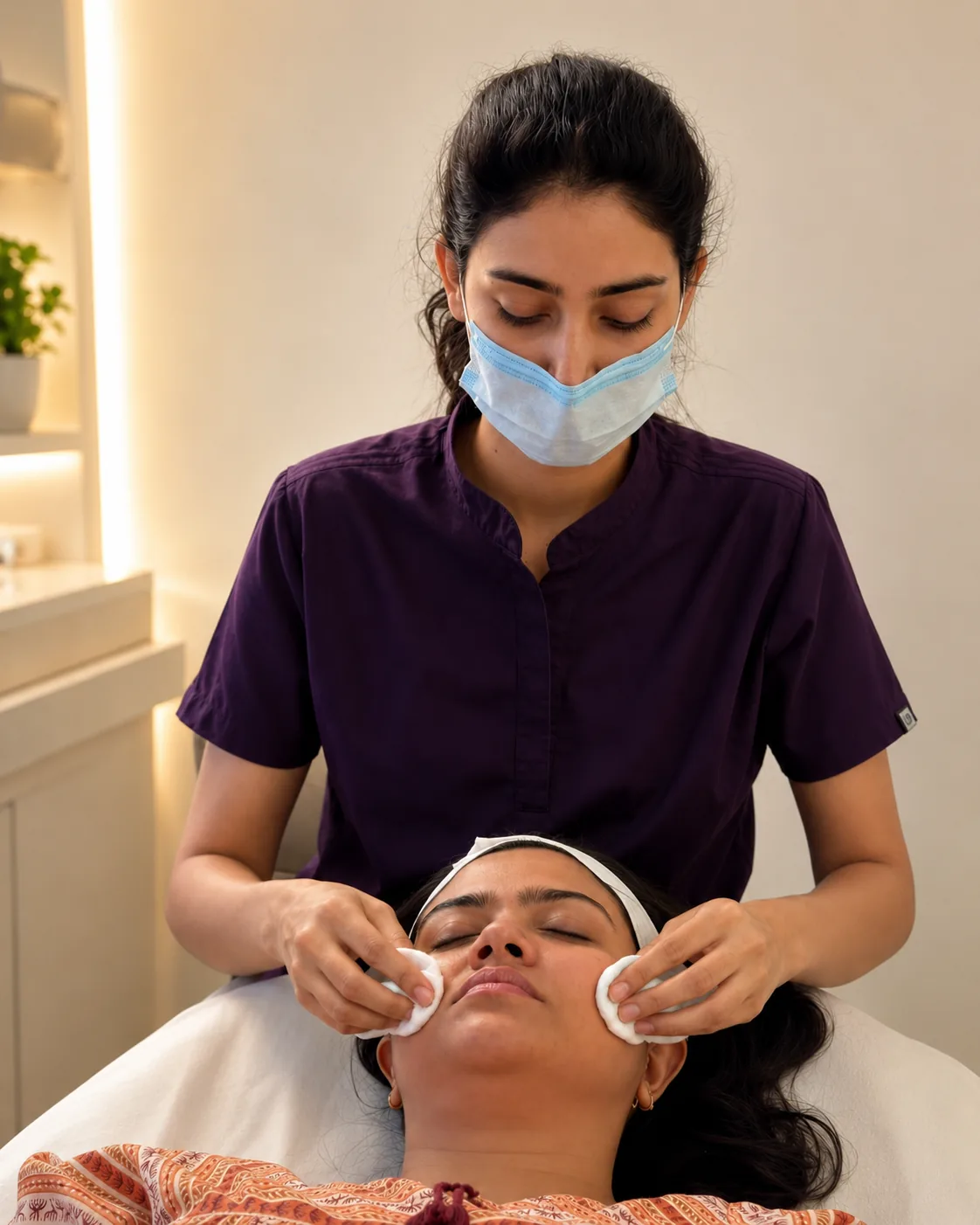
Fifteen to twenty minutes with the carbon on, a soft crackle and warmth during the laser passes, then a wipe-down that removes the remaining carbon with the debris it caught. The skin looks cleaner, brighter and more matte immediately, with pores visibly tighter over the following days; there is no peeling and no downtime, and makeup can be worn the next morning. The effect of one session lasts three to four weeks; a monthly series builds the pore and oil-control benefit and the mild collagen effect of the second pass. The carbon facial does not treat deep scars, pigmentation below the surface or hormonal acne on its own — the plan around it does. Results vary from person to person.
Where we use Activated Carbon (Carbon Facial) at AI Aesthetics
The treatments at our C-Scheme clinic that actually include it — each page explains the full protocol, suitability and price.
Carbon facial: frequently asked questions
What does the carbon in a carbon facial do?
Two things: it adsorbs sebum, dead cells and surface debris into its porous structure, and it absorbs the 1064 nm Q-switched laser pulse so the energy is released at the surface, where the carbon shatters and takes the debris with it — a precise, no-downtime exfoliation.
Is a carbon facial the same as a Q-switched laser treatment?
The carbon facial uses the Q-switched laser with carbon applied first, which keeps the effect at the surface for oil, pores and polish. The same laser without carbon is used differently, for pigmentation and toning.
Is activated carbon safe on skin?
Yes — it is an inert, non-reactive material. Reactions to carbon itself are rare; the restrictions on the carbon facial come from the laser, not the carbon.
Who is the carbon facial best for?
Oily, congested, acne-prone and dull skin with visible pores — the pattern Jaipur’s summer film and monsoon humidity produce. Our treatment engine treats it as a valid corrective for active acne and compares it directly with salicylic peels.
Does the carbon facial help active acne?
Yes — it is one of the energy-based correctives our constraints allow for active acne lesions, usually paired with a salicylic spot step on the lesions themselves.
What is the charcoal peel-off mask?
A laser-free way to use carbon’s adsorption for oil control at the end of a cleansing facial. It is chosen for oily and combination skin, and for clients who cannot have the laser that day.
Why was my carbon facial postponed?
The laser rules apply: more than two hours of daily sun, travel or an event within seven days, acids used yesterday, retinol within 24 hours, any laser in the past week, pregnancy, or an elevated facial surface temperature all block it. The charcoal mask can usually stand in.
Does a carbon facial hurt or need downtime?
No. There is warmth and a soft crackle during the passes, brief pinkness afterwards, no peeling and no downtime.
How often should I have a carbon facial?
Monthly for a series, which builds the pore and oil-control benefit and the mild collagen effect of the second pass. A single session gives same-day polish that lasts three to four weeks.
Does the carbon facial lighten skin?
No. It removes surface debris and dead cells, which makes skin look brighter and more even, but it does not change skin colour and is not a brightening treatment in the pigment sense.