Hard Water and Your Skin and Hair in Jaipur: What the Minerals Do, and What Actually Helps
A good share of the dryness, dullness, flaking scalps and ‘sensitive skin’ we see in C-Scheme has the same cause, and it is not a skin condition. It is the water. Jaipur sits on hard groundwater, and much of the city — including areas supplied by borewells and tankers — washes in water carrying several hundred milligrams of dissolved calcium and magnesium per litre. This guide explains what those minerals do to the skin barrier and the hair shaft, how to recognise a hard-water problem rather than treating it as eczema or hair fall, and the fixes that work, from the cheap ones to the clinic ones.
Content verified by Dr. Aakriti Mehra · Last reviewed October 2026 Editorial policy
4.9 · 30 Google reviews




What hard water actually does
- It stops soap working: calcium and magnesium react with cleansers to form an insoluble scum that does not rinse away. You use more product, and a film stays on the skin and hair.
- It leaves a mineral residue on the skin that stiffens the surface, raises its pH, and interferes with the enzymes that finish the barrier’s lipids — which is why skin feels tight and ‘squeaky’ after washing.
- It strips barrier lipids: the surfactant-mineral combination removes ceramides and fatty acids more aggressively than soft water does, so the barrier leaks water and lets irritants in.
- It aggravates eczema and sensitive skin: studies in hard-water regions show higher rates of childhood eczema and more barrier damage after washing, with the effect strongest in people who already have a weak barrier.
- On hair, the minerals deposit on the cuticle, leaving it rough, dull, tangle-prone and brittle; colour fades faster and the scalp carries a residue that feeds flaking and itch.
- On the scalp, the same residue plus a raised pH favours the yeast behind dandruff and the folliculitis that pushes follicles into shedding.
Is it the water or the skin? How to tell
| Sign | Points to hard water | Points to a skin or scalp condition |
|---|---|---|
| Tightness after washing | Immediate, everywhere washed, better with filtered water | Localised, persists regardless of water |
| Dullness | A grey film that improves with a chelating or acid rinse | Uneven tone, pigmentation pattern |
| Itch | After washing, scalp and body, no rash | Rash, scaling, defined patches |
| Hair | Rough, tangly, dull, builds up; better after a trip to a soft-water city | Thinning at the crown or parting, shedding that continues with any water |
| Dandruff | Fine white flakes, worse after washing, no inflammation | Greasy yellow scale, redness, or thick plaques |
| Travel test | Skin and hair improve within days away from Jaipur | No change |
The travel test is the one we trust most: clients whose skin and hair ‘magically’ improve on a week in Mumbai or Goa and relapse on return are telling us about water, not genetics.
Fixes that work, in order of cost
- Final rinse with filtered or RO water for the face, and for the hair where practical — a jug is enough. This is the single most effective change and it costs nothing.
- Cleanser choice: a low-foam, syndet (non-soap) cleanser for the face and body; bar soap is the worst performer in hard water.
- Shower-head filters: inexpensive, modest effect; they reduce chlorine and sediment more than hardness, but clients notice the difference.
- Chelating shampoo once a week, or an apple-cider-vinegar or citric-acid rinse once a fortnight, to strip the mineral film from hair and scalp; follow with conditioner.
- Lipid replacement: a ceramide moisturiser after every wash, because hard-water washing removes more lipid than soft; squalane for oily skin.
- Leave-in conditioner or a light serum on hair ends; the cuticle needs smoothing because the water roughens it.
- A whole-house or bathroom softener if you own the home and the budget allows; the only complete fix.
Hard water and acne
Clients expect hard water to cause acne; it rarely does directly. What it does is leave a film that mixes with sebum and sunscreen residue, so the pores are more congested and the cleanser you reach for in frustration is harsher — and the barrier damage from that is what makes the acne worse. The answer is not a stronger wash; it is a better rinse, a gentler cleanser and a salicylic step two or three nights a week.
Hard water and hair fall
Hard water does not kill follicles. It makes hair break — rough, mineral-coated shafts snap when brushed — and it keeps the scalp in a state of mild irritation and flaking that increases shedding. A client who arrives with ‘hair fall’ and a brush full of short, broken hairs has a hard-water and breakage problem; a client with long hairs with the bulb attached has true shedding. The two need different plans, and the assessment at the start of any hair-fall plan here includes the water question.
Hair fall treatment — the assessment that separates breakage from shedding →
What the clinic adds
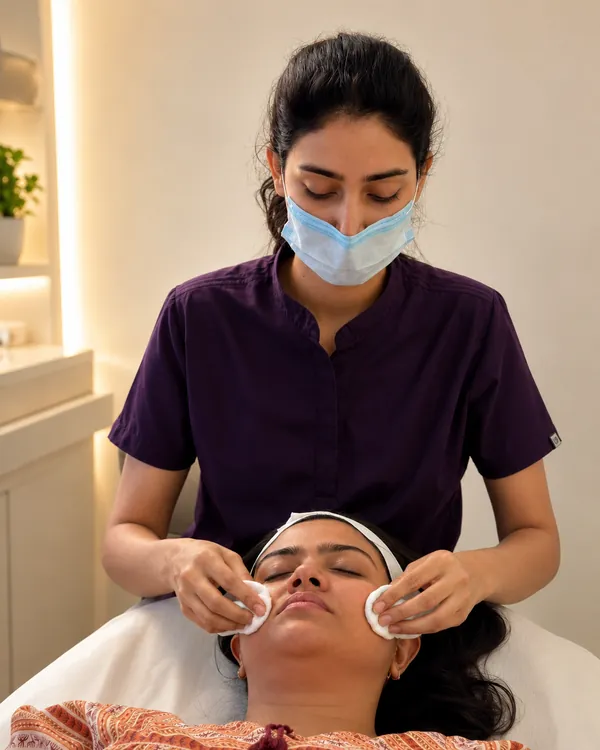
- Barrier repair protocols — hydradermabrasion with hyaluronic infusion, calming LED, ceramide finish — for skin that hard water has left reactive
- Scalp health sessions that remove mineral and product build-up, treat flaking and prepare the scalp before any hair-growth treatment
- A home routine written around your water: cleanser, rinse, moisturiser and shampoo chosen for hard water rather than for a global product catalogue
- A clear line between what the water is doing and what needs treating, so money is not spent on eczema creams for a rinse problem or hair injections for breakage
Scalp health treatment — clearing build-up before growth treatments →
Jaipur specifics
- Tanker water in summer is often harder than the piped supply; skin and hair worsen in May for a water reason as well as a heat one.
- Post-treatment skin — after peels, lasers and clean-ups — stings in hard water for a few days; a filtered-water rinse for that week is part of our aftercare.
- Colour-treated hair fades fastest in hard water; a chelating rinse before colouring and a filtered rinse after helps.
- Children and anyone with eczema in the house benefit most from a bathroom softener; it is a health purchase, not a beauty one.
Hard water, skin and hair: frequently asked questions
Does hard water cause dry skin?
Yes. The minerals stop cleansers rinsing cleanly, leave a stiffening film, raise the skin’s pH and strip more barrier lipid than soft water, so skin feels tight and leaks water. A filtered final rinse and a ceramide moisturiser reverse most of it.
Does hard water cause hair fall?
It causes breakage and scalp irritation rather than follicle loss: rough, mineral-coated hair snaps, and a flaky, irritated scalp sheds more. True shedding (hairs with the bulb) needs a different plan from breakage (short, snapped hairs).
How do I know if my skin problem is hard water?
Tightness immediately after washing wherever you washed, a grey dullness that lifts with an acid rinse, and clear improvement within days of travelling to a soft-water city all point to water rather than a skin condition.
What is the cheapest fix for hard water?
A jug of filtered or RO water as the final rinse for the face and hair, and a non-soap cleanser. These two changes cost almost nothing and do most of the work.
Do shower filters soften water?
Mostly no; they remove chlorine and sediment and reduce hardness only slightly. A true softener is a bigger installation. Filters still help enough that many clients notice.
Does hard water make dandruff worse?
Yes. The mineral residue and raised pH favour the yeast behind dandruff and irritate the scalp. A weekly chelating shampoo and a filtered final rinse help; persistent flaking with redness needs a scalp assessment.